
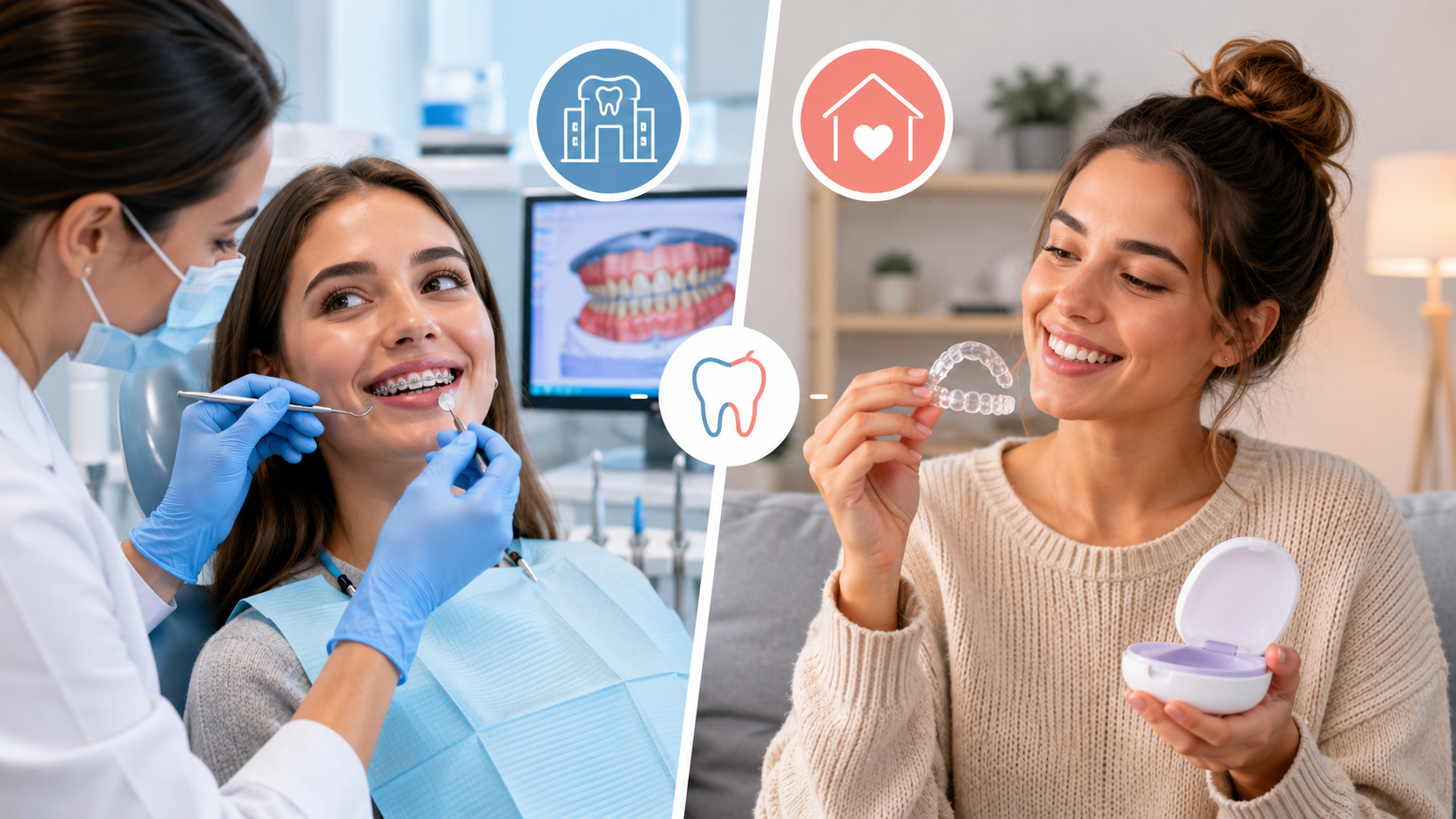
The rise of clear aligners has led more people to seek treatments to correct the position of their teeth. Alongside treatments performed in dental clinics, at-home orthodontic systems have emerged, promising to align the smile through a mostly remote process. However, although both models pursue the same goal, there are important differences in diagnosis, medical supervision, safety, treatment capacity, and long-term results.
Understanding these differences is essential to making an informed decision. Orthodontics is not only about moving visible teeth; it involves modifying complex biological structures that affect the bite, chewing function, gum health, and the future stability of the smile.
What is orthodontic treatment at a dental clinic?
Orthodontic treatment at a dental clinic is performed under the direct supervision of an orthodontist. Before starting, a complete study is carried out, including a clinical examination, photographs, X-rays, bite analysis, and digital planning.
The goal is not only to align teeth, but to achieve a functional and stable relationship between teeth, gums, bone, and jaw joints.
Elements included in an in-person diagnosis
- Complete clinical examination.
- Panoramic X-ray.
- Lateral cephalometric X-ray.
- Digital intraoral scan.
- Bite analysis.
- Periodontal evaluation.
- Temporomandibular joint assessment (TMJ).
This information makes it possible to detect problems that are not visible in photographs or partial scans.
What is at-home orthodontics?
At-home orthodontics uses clear aligners designed from records obtained through impression kits or scans performed outside a traditional clinical setting. Follow-up is usually carried out remotely through mobile apps, photographs, or video calls.
This model aims to simplify the process and reduce in-person visits. However, the level of diagnostic information available is usually lower than in a complete orthodontic study performed at a dental clinic.
Common features of at-home orthodontics
- Mainly remote evaluation.
- Fewer in-person visits.
- Follow-up through photographs.
- Usually focused on mild or moderate cases.
- Use of clear aligners.
The most important difference: the initial diagnosis
The main difference between both models is not the aligners, but the diagnosis.
An aligner is simply a tool. What truly matters is knowing how the teeth should move, how far they can be moved safely, and what anatomical limitations each patient has.
In a dental clinic, aspects that cannot be assessed through photographs alone are analyzed:
- Position of the tooth roots.
- Amount of available bone.
- Condition of the gums.
- Presence of hidden cavities.
- Joint problems.
- Root resorption.
- Impacted teeth.
These factors can completely change the treatment plan.
Esthetic orthodontics vs. functional orthodontics
One of the most important concepts in orthodontics is the difference between tooth alignment and functional correction.
A patient may have apparently straight teeth and still have an incorrect bite.
Modern orthodontics aims to achieve:
- Dental alignment.
- Proper occlusion.
- Muscle balance.
- Long-term stability.
- Periodontal health.
- Efficient chewing function.
When treatment focuses only on visual changes, functional problems may remain unresolved.
The importance of medical supervision during treatment
Teeth do not move through bone automatically. Each movement triggers a biological response known as bone remodeling.
During this process, issues may arise that require clinical adjustments.
Situations that may require professional intervention
- Movements progressing more slowly than expected.
- Gum inflammation.
- Poor aligner fit.
- Unexpected bite changes.
- Tooth wear.
- Persistent pain.
- Need for refinements.
In-person check-ups allow these situations to be detected before they lead to more serious problems.
What types of cases can be treated?
Not all patients have the same orthodontic complexity.
Mild cases
- Minor crowding.
- Mild spacing between teeth.
- Relapse after previous orthodontic treatment.
Moderate cases
- Significant crowding.
- Crossbites.
- Midline deviations.
- Spacing problems.
Complex cases
- Severe malocclusions.
- Skeletal problems.
- Joint disorders.
- Multidisciplinary treatments.
- Patients with periodontal disease.
The greater the complexity, the more important ongoing clinical supervision becomes.
The role of X-rays in orthodontics
X-rays are a fundamental diagnostic tool. They allow specialists to observe structures that are invisible during a conventional examination.
They help identify:
- Position of the roots.
- Condition of the alveolar bone.
- Impacted teeth.
- Periapical lesions.
- Root resorption.
- Anatomical alterations.
Without this information, anticipating certain biological risks becomes more difficult.
Potential risks when treatment is not properly supervised
The vast majority of orthodontic treatments progress successfully when proper planning is in place. However, every tooth movement involves biological changes that must be monitored.
Possible complications
- Unstable bite.
- Insufficient movements.
- Excessive movements.
- Gum inflammation.
- Early relapse.
- Tooth wear.
- Joint discomfort.
The best way to minimize these risks is through a thorough diagnosis and regular check-ups.
Is at-home orthodontics always a bad option?
Not necessarily. Some patients with very limited needs may achieve satisfactory results with remote systems.
However, it is important to understand that diagnostic and therapeutic capacity is usually more limited than in a treatment performed under continuous clinical supervision.
The choice should be based on the real needs of the case, not only on cost or convenience.
Initial cost vs. real treatment value
Price is a common comparison between both models.
However, comparing only the initial cost can be misleading.
What orthodontic treatment at a dental clinic usually includes
- Complete diagnosis.
- X-rays.
- Intraoral scan.
- Personalized planning.
- Regular check-ups.
- Clinical adjustments.
- Refinements.
- Final retention.
What to consider before comparing prices
- Number of visits included.
- Diagnostic tests.
- Final retainers.
- Additional refinements.
- Management of treatment issues.
The real value of treatment should be assessed by considering the entire process, not only the initial price.
The most overlooked phase: retention
Finishing orthodontics does not mean the treatment is over.
Teeth have a natural tendency to shift over time. This is known as orthodontic relapse.
For this reason, retainers are used once the desired position has been achieved.
Goals of retention
- Maintain the results obtained.
- Prevent relapse.
- Stabilize the bite.
- Preserve tooth alignment.
A proper retention strategy is just as important as the active phase of treatment itself.
How to choose the best option for your case
There is no single solution that works for every patient.
The decision should be made after evaluating:
- Case complexity.
- Condition of the gums and bone.
- Esthetic and functional goals.
- Need for clinical supervision.
- Available budget.
- Long-term expectations.
A professional evaluation helps determine which option offers the best guarantees of success.
Frequently asked questions about orthodontics at a dental clinic (FAQs)
The main difference is not the aligner itself, but the diagnosis, planning, and professional supervision that accompany the treatment.
It depends on the case. Complex bite problems usually require more thorough clinical control.
X-rays provide essential information about roots, bone, and anatomical structures that cannot be observed externally.
Orthodontic relapse may occur. That is why it is essential to use the retainers recommended by the orthodontist.
Duration depends on the complexity of the case, although most treatments usually last from several months to approximately two years.
Conclusion
Modern orthodontics goes far beyond achieving an aligned smile. Its goal is to create a balanced relationship between teeth, bone, gums, and bite to ensure healthy, stable long-term results.
Although at-home orthodontic systems may seem attractive because of convenience or price, the key difference lies in clinical diagnosis, the ability to treat complex cases, and professional supervision throughout every phase of treatment.
When seeking a complete, safe, and personalized correction, orthodontic treatment at a dental clinic remains the approach that offers the highest level of control, predictability, and long-term stability.