
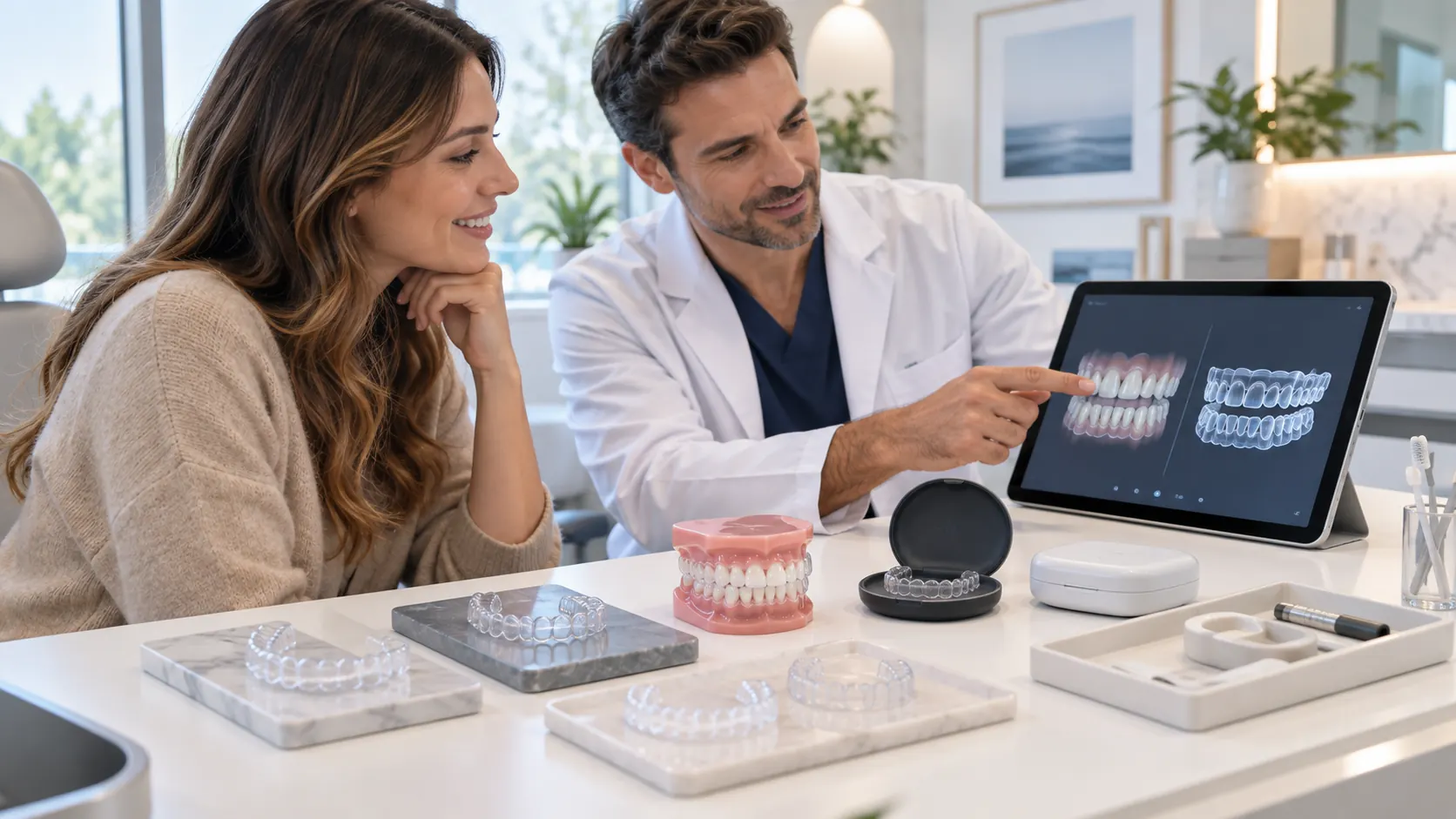
Invisible orthodontics is not a single treatment. The term includes different orthodontic systems designed to move teeth while reducing the visibility of the appliance during treatment.
The main options are removable clear aligners and fixed lingual braces. Traditional braces are not invisible, but they provide an important clinical reference point when comparing treatment alternatives.
Choosing the right option requires evaluating the bite, the movements needed, the health of the teeth and gums, patient compliance, aesthetic preferences, and treatment goals.
What is invisible orthodontics and how does it work?
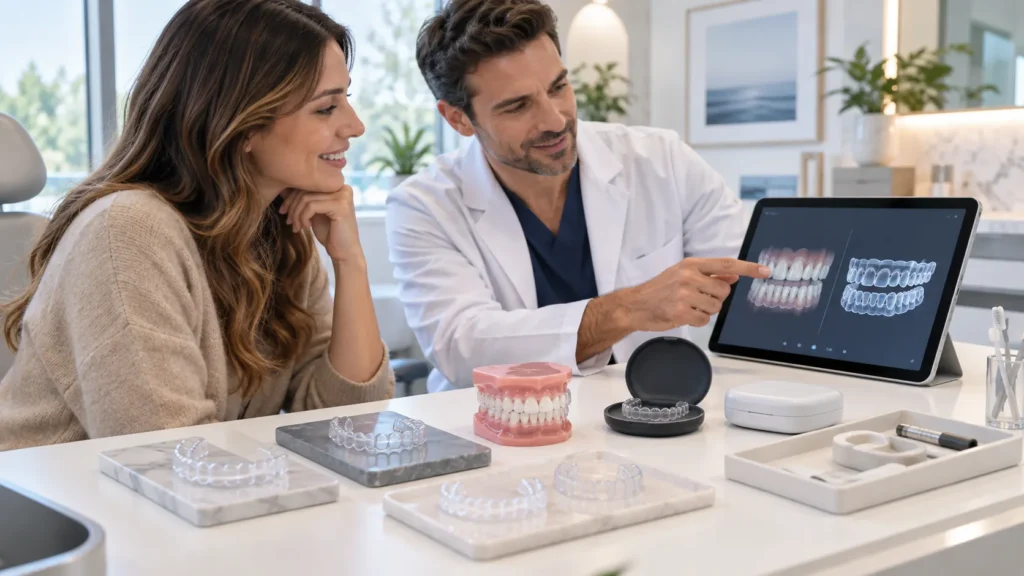
Invisible orthodontics: a group of less visible orthodontic treatments that apply controlled forces to gradually change tooth position and correct certain bite problems.
Malocclusion: an alteration in tooth position or in the way the upper and lower dental arches fit together. It may include crowding, gaps, overbite, crossbite, or open bite.
Teeth do not move into their new positions all at once. The appliance applies planned forces that produce gradual movement. The technique used determines how those forces are generated and controlled.
A complete orthodontic treatment usually follows this sequence:
- Diagnosis: evaluation of the teeth, gums, bite, and related structures.
- Planning: definition of treatment goals and the tooth movements required.
- Active treatment: application of forces using clear aligners, lingual braces, or traditional braces.
- Monitoring: follow-up visits to assess progress and make adjustments.
- Retention: maintaining the achieved tooth position with retainers.
Intraoral scanning and digital treatment planning make it possible to visualize and sequence tooth movements. However, a digital simulation is a clinical planning tool and not an exact guarantee of the final result.
Main types of invisible orthodontics
Clear aligners: Invisalign and other systems
Clear aligner: a custom-made removable tray that covers the teeth and applies programmed forces to gradually move them toward a planned position.
Invisalign is a brand of clear aligners, not a synonym for all invisible orthodontic treatment. Different systems use sequences of customized aligner trays.
Each aligner corresponds to a specific stage of treatment. The patient wears a sequence of trays according to professional instructions and attends follow-up visits to monitor progress.
For certain movements, attachments, elastics, or other auxiliary elements may be used. Attachments are small tooth-colored shapes bonded to the teeth that allow forces to be applied with greater control.
- Aesthetics: the transparent material significantly reduces the visibility of the appliance.
- Removability: aligners can be removed for eating and oral hygiene.
- Compliance: treatment success also depends on following the recommended daily wear schedule.
- Planning: tooth movements are organized through a previously designed sequence.
- Hygiene: removing the aligners makes brushing and interdental cleaning easier.
- Limitations: certain complex movements may require auxiliaries or a different treatment strategy.
Clear aligners may be especially appealing to patients who prioritize aesthetics, oral hygiene, and the ability to temporarily remove the appliance. That flexibility requires active patient participation throughout treatment.
Lingual braces: brackets placed behind the teeth
Lingual braces: a fixed orthodontic system in which brackets and wires are placed on the inner surfaces of the teeth, facing the tongue.
The main aesthetic advantage is that the appliance is almost completely hidden from a frontal view. Unlike clear aligners, it remains fixed in place throughout treatment.
Lingual braces apply forces through fixed orthodontic appliances and require specific professional expertise. During the initial adjustment period, some patients may experience tongue irritation or temporary changes in speech.
- Visibility: very limited when viewed from the front of the smile.
- How they work: they use brackets and wires bonded to the teeth.
- Compliance: they do not depend on remembering to wear the appliance every day.
- Hygiene: careful cleaning around the brackets and wires is required.
- Adjustment: initial tongue discomfort may occur.
- Control: they allow tooth movements to be managed through fixed-appliance biomechanics.
Dental anatomy, bite, and case complexity all influence whether lingual braces are appropriate. For this reason, they should not automatically be considered suitable for every patient.
Clear aligners vs. traditional braces
Traditional braces are usually bonded to the front surfaces of the teeth. Although they are more visible, they remain an important reference because they can control a wide variety of orthodontic movements.
Current evidence does not show that clear aligners are universally better than braces. Effectiveness depends on the type of malocclusion, the movements required, and patient cooperation.
A 2026 systematic review analyzing 15 trials and 1,084 patients found no significant differences in treatment quality or duration in certain non-extraction cases.
In extraction cases, the same review found greater control with fixed appliances. The authors noted that study heterogeneity and limited follow-up reduced the certainty of some conclusions.
- Aesthetics: clear aligners and lingual braces have less visual impact.
- Removability: aligners can be removed; braces remain fixed.
- Hygiene: oral hygiene is generally easier with removable appliances when they are used correctly.
- Compliance: especially important with clear aligners.
- Biomechanics: certain movements may be more controllable with fixed appliances.
- Eating: aligners are removed for meals; braces require specific dietary precautions.
- Follow-up: all systems require professional monitoring.
- Retention: every treatment option requires a long-term maintenance strategy.
A 2026 systematic review and meta-analysis found better periodontal outcomes and less initial pain with clear aligners than with fixed appliances. The authors themselves recommended interpreting these findings cautiously because of differences among the included studies.
How to choose between clear aligners, lingual braces, and traditional braces
The right question is not “Which orthodontic treatment is best?”, but rather “Which system can achieve the required tooth movements with the right balance of control, oral health, aesthetics, and patient compliance?”
Mild crowding, a crossbite, an open bite, or a treatment involving extractions do not have the same clinical requirements. Diagnosis should always come before selecting the appliance.
The main criteria for comparing treatment options include:
- Complexity of the malocclusion: determines the level of biomechanical control required.
- Planned tooth movements: rotation, tipping, intrusion, extrusion, torque, or bodily movement can present different challenges.
- Periodontal health: the gums and supporting tissues should be stable before and during orthodontic treatment.
- Compliance: clear aligners require strict adherence to the recommended wear schedule.
- Aesthetics: may influence the choice between visible and less visible systems.
- Hygiene: each appliance has different cleaning requirements.
- Need for auxiliaries: attachments, elastics, or other tools may be required.
- Clinical expertise: the professional should understand the possibilities and limitations of the selected system.
- Expected duration: depends mainly on the case rather than only on the brand of appliance.
- Post-treatment retention: should be planned from the beginning.
In selected cases, techniques can be combined. Using attachments or elastics with aligners does not mean the treatment has failed; they are tools used to control specific tooth movements.
Refinement: an additional phase of clear aligner treatment that may be recommended when some teeth have not fully reached their planned positions and the treatment plan needs to be adjusted.
The possibility of needing refinements is another reason why an initial digital simulation should not be interpreted as an exact prediction of the number of aligners, treatment duration, or final result.
Price, treatment time, and the true cost of invisible orthodontics
There is no single price for invisible orthodontic treatment. Cost depends on case complexity, the system selected, treatment duration, diagnostic testing, and the follow-up care included.
The number of aligners, refinements, use of auxiliaries, post-treatment retainers, and any necessary preliminary dental care may also affect the total price.
For this reason, comparing advertised prices alone can be misleading. Two treatments that appear similar may include very different levels of diagnosis, follow-up visits, refinements, or retention.
Treatment duration also does not depend solely on whether Invisalign, lingual braces, or traditional braces are used. The number and difficulty of the required movements, biological response, and patient cooperation can all affect treatment time.
Available studies show comparable results between clear aligners and fixed appliances in many mild or moderate non-extraction cases. The evidence becomes less consistent as case complexity increases.
If financing is available, it is advisable to compare the total cost of treatment, financing terms, and services included rather than focusing only on the monthly payment.
Retention: what happens after orthodontic treatment is finished?
Orthodontic retention: the phase after active tooth movement designed to help maintain tooth position after braces are removed or clear aligner treatment is completed.
Teeth may shift over time. For this reason, retention is part of orthodontic treatment and should not be considered optional.
There are fixed retainers bonded to the inner surfaces of certain teeth and removable retainers. The type selected and wear schedule depend on the individual case.
Long-term stability requires a combination of retention, good oral hygiene, regular check-ups, and periodontal health monitoring. An aligned smile requires maintenance after active treatment is complete.
Frequently asked questions about invisible orthodontics (FAQs)
It depends on the case. Crowns may participate in certain orthodontic movements, but osseointegrated dental implants do not move like natural teeth. Treatment planning must take existing restorations into account.
They should be cleaned according to the recommendations provided by the dental professional and manufacturer. It is also important to maintain proper oral hygiene before putting the aligners back in.
You should contact the dental office. Depending on the stage of treatment, it may be necessary to temporarily use another aligner, order a replacement, or modify the planned sequence.
In general, it is recommended to remove them before drinking anything other than water. Some beverages can stain the material or trap sugars and acids against the teeth.
Some patients experience temporary changes in pronunciation during the adjustment period. Tongue irritation may also occur, and its intensity varies from person to person.
In selected cases, yes, but a new evaluation is required. The change must maintain the biomechanical goals of treatment and should not be based only on aesthetic preference.
It can correct certain bite problems in addition to aligning the teeth. The actual possibilities depend on the diagnosis, severity of the problem, and movements required.
Yes. Retainers help keep the teeth in their achieved positions and are part of the final phase after clear aligners as well as other orthodontic treatments.
The best comparison of invisible orthodontic options is not about choosing a brand, but about comparing treatment strategies. Diagnosis, biomechanics, oral health, compliance, aesthetics, and retention determine which option makes the most sense.
At Clínica Dental Torres, every treatment begins with an individual evaluation. The goal is to analyze the available alternatives and select a solution tailored to each patient’s clinical and personal needs.