
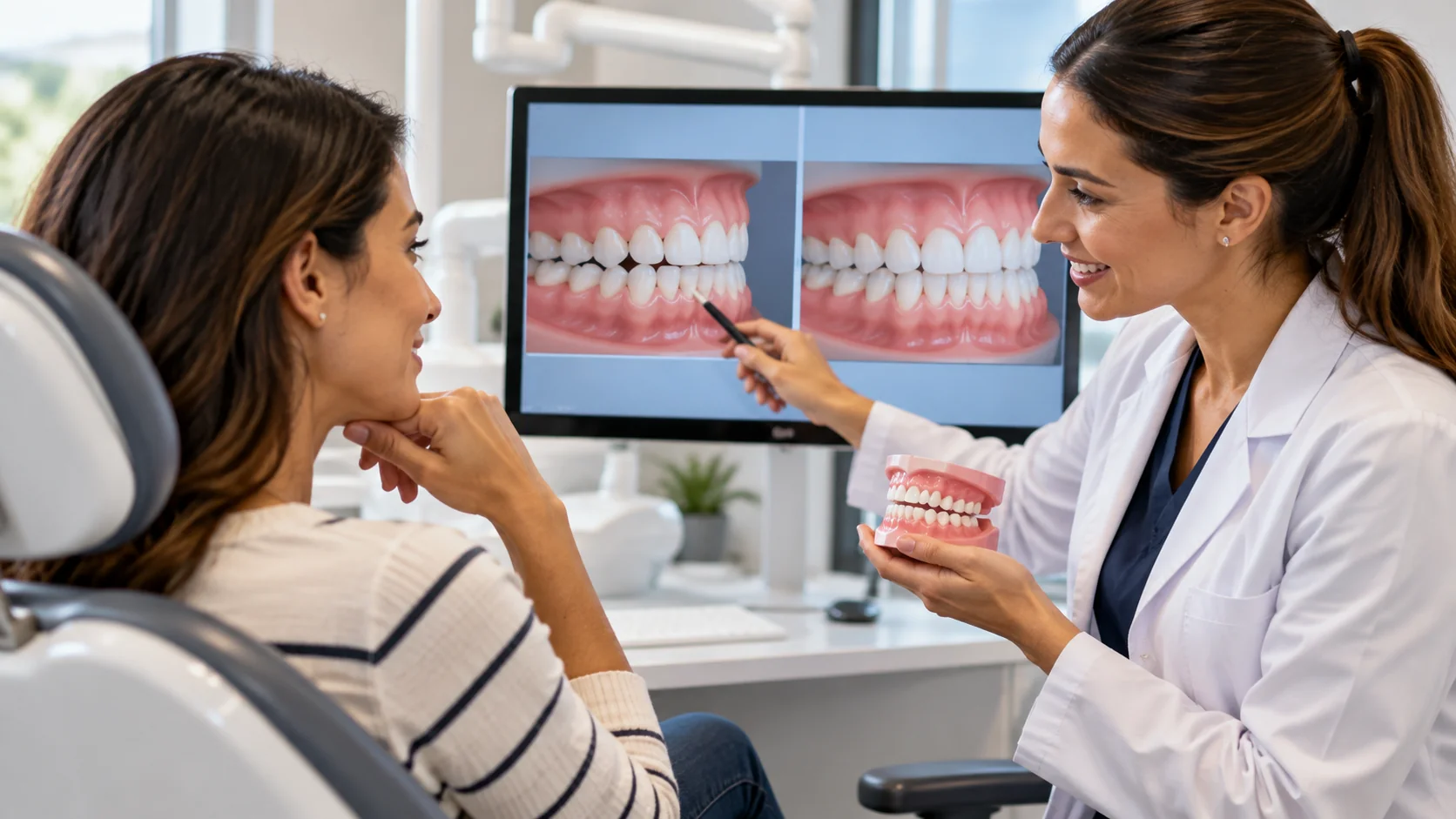
A crossbite in adults is a malocclusion in which one or more upper teeth bite inside the lower teeth. It may affect the front teeth, back teeth, one side, or both sides.
The key is to determine whether the cause is dental, functional, or skeletal. Each component has different treatment possibilities and limitations.
Orthodontic treatment for crossbite in adults can correct many dental cases. If there is a significant skeletal discrepancy, other techniques may need to be considered.
What is a crossbite and what types are there?
An anterior crossbite occurs when one or more upper front teeth bite behind the lower front teeth.
A posterior crossbite occurs when the upper premolars or molars bite inside the corresponding lower teeth.
- Dental: mainly related to the position or inclination of the teeth.
- Skeletal: there is a discrepancy between the bony bases of the upper and lower jaws.
- Functional: the lower jaw shifts when closing to find a position where the teeth can make contact.
- Unilateral or bilateral: affects one or both sides of the dental arch.
How is a crossbite diagnosed in adults?
An orthodontic diagnosis determines which structures are causing the malocclusion and which movements would be needed to correct it. It should not be based solely on the appearance of the smile.
- Evaluation of the bite and tooth contacts.
- Assessment of dental midlines and jaw deviations.
- Analysis of tooth position, inclination, and available space.
- Photographs, models, or digital scans.
- X-rays when they provide necessary diagnostic information.
- CBCT only when three-dimensional information is clinically justified.
The goal is to determine how much of the problem comes from tooth position and how much comes from the underlying skeletal structures. This helps avoid trying to correct a significant skeletal discrepancy simply by tipping the teeth.
What can orthodontics correct in an adult crossbite?
Orthodontics moves teeth within biological limits. It can change tooth position, inclination, rotation, and transverse relationships when there is adequate periodontal support.
- Move one or more teeth out of crossbite.
- Correct tooth inclinations and rotations.
- Coordinate the width of the dental arches.
- Resolve some associated crowding.
- Improve improper tooth contacts.
The limitation arises when correction would require moving the teeth outside safe bony support or when the problem primarily involves the upper or lower jaw itself.
Clear aligners or braces for crossbite
Clear aligners
Clear aligners are removable trays that apply programmed forces. They may be used for certain dental crossbites and for dentoalveolar expansion.
A 2026 systematic review in adults found approximately 72% to 81% predictability for transverse maxillary expansion, depending on the dental region.
The evidence came from six retrospective studies involving 233 patients. In addition, part of the expansion occurs through buccal tipping of the tooth crowns.
Braces
Braces are fixed appliances that transmit forces through wires and auxiliary components. They provide continuous control of tooth movement and more complex orthodontic mechanics.
Why does occlusion matter?
Occlusion is the relationship between the upper and lower teeth when the jaw closes and moves. A crossbite can alter tooth contacts and contribute to functional jaw shifts.
A crossbite should not automatically be assumed to cause bruxism, temporomandibular pain, or headaches. These are multifactorial conditions and require a specific evaluation.
When might moving the teeth alone not be enough?
In adults, jaw growth is already complete. A significant skeletal transverse deficiency may exceed what can reasonably be corrected through tooth movement alone.
Microimplant-assisted expansion aims to increase the skeletal effect by using bone-supported anchorage and may be considered in selected adults with transverse maxillary deficiency.
For larger discrepancies, surgically assisted expansion or orthognathic surgery may also be evaluated. The indication depends on the patient’s anatomy and individual diagnosis.
How is treatment planned?
- 1. Locate: anterior, posterior, unilateral, or bilateral.
- 2. Identify: dental, functional, skeletal, or combined origin.
- 3. Define the limits: evaluate bone, gums, roots, and available space.
- 4. Choose: clear aligners, braces, or complementary techniques.
- 5. Monitor: assess actual tooth movement and adjust the plan as needed.
- 6. Retain: maintain the correction after the active phase is completed.
Retention is the phase designed to maintain the tooth positions achieved during treatment. The type and duration of retention depend on the movements performed and the risk of relapse.
Adult crossbite treatment in Vigo
At Clínica Dental Torres, with more than 30 years of experience, we evaluate crossbite in adults in Vigo by assessing the teeth, gums, bone, jaws, and function.
The goal is to determine what can be corrected with clear aligners or braces and identify when the discrepancy requires additional treatment options to be considered.
Frequently asked questions about crossbite in adults (FAQs)
Not necessarily. In adults, it does not correct itself spontaneously, and dental or periodontal changes over time may affect the available treatment options.
Yes. Many dental crossbites can be treated with orthodontics. Surgery is mainly considered when there is a significant skeletal discrepancy.
There is no single treatment time that applies to everyone. It depends on the cause, the teeth involved, the movements required, the biological response, and the treatment plan.
It may be possible, but the periodontal tissues should be evaluated first. Bone support and gum health influence which tooth movements can be performed safely.
Relapse can occur. Long-term stability depends on the type of correction, anatomy, function, and adherence to the retention protocol.
Diagnosis before the appliance: the key to treatment
A crossbite in adults may involve a combination of tooth position, skeletal discrepancy, and functional adaptation. For this reason, treatment should always begin with a proper diagnosis.
At Clínica Dental Torres, an orthodontic evaluation in Vigo can identify the origin of the problem, establish realistic treatment goals, and select a strategy tailored to each patient.