
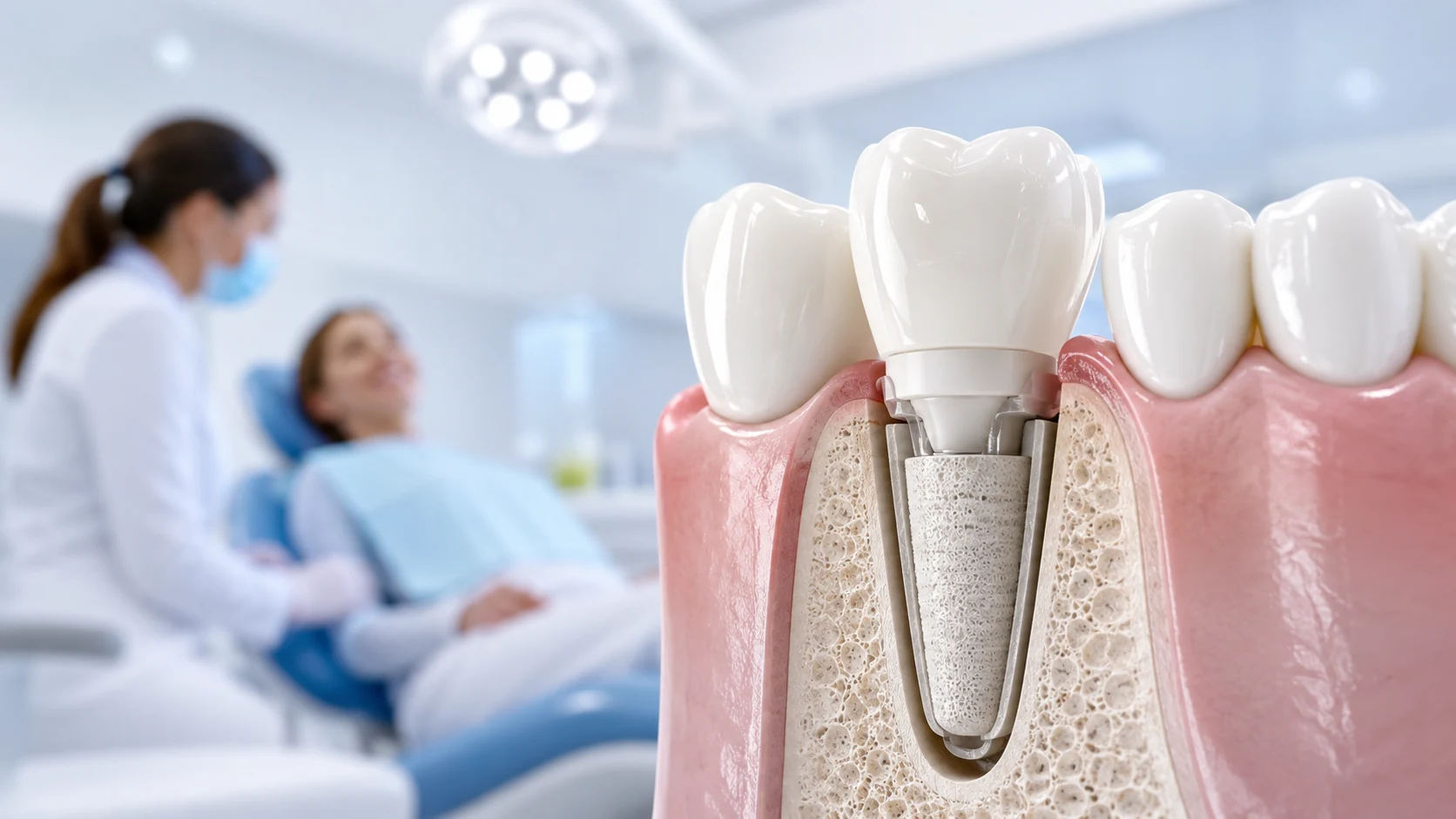
Dental implants with no visible screws are an implant dentistry solution designed to replace missing teeth with a natural, comfortable, and highly aesthetic result. This concept does not mean that the treatment uses no fixation components at all, but rather that the visible part of the restoration is designed so that the screw access does not appear on the dental crown.
In clinical practice, the implant acts as an artificial root integrated into the bone, while the crown is the visible part that reproduces the shape, color, and function of a natural tooth. The difference lies in how that crown is attached to the implant and how the most harmonious result possible is achieved.
At Clínica Dental Torres in Vigo, we study each case through personalized diagnosis, 3D digital technology, and advanced implant planning to determine whether screwless-looking dental implants are the most appropriate option for each patient.
What does it mean to talk about dental implants with no visible screws?
Talking about dental implants with no visible screws means that the final restoration does not show a screw access hole in the visible area of the crown. This solution can be achieved through cement-retained prostheses, prosthetic designs with hidden access, or customized systems that aim to improve aesthetics without compromising function.
The choice of system depends on several factors: implant position, available space, gum condition, bone quality, bite type, maintenance needs, and the patient’s aesthetic expectations.
For this reason, it should not be understood as a universal technique or as a superior option in every case. The best solution is the one that combines aesthetics, stability, hygiene, and long-term ease of review.
Parts of a dental implant: implant, abutment, and crown
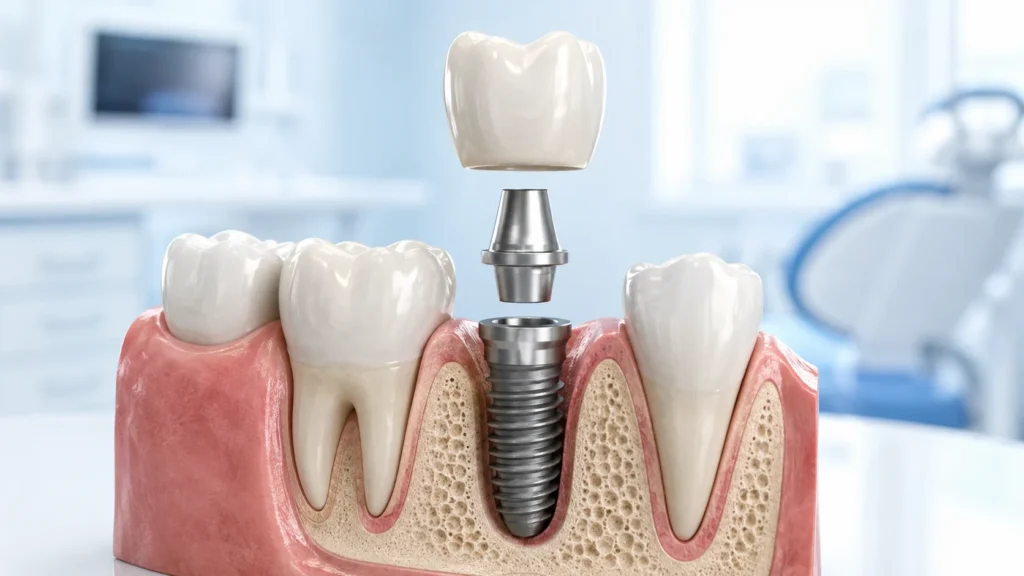
To understand the different types of dental implants, it is important to distinguish their main components.
- Dental implant: the structure placed in the bone that functions as an artificial root.
- Prosthetic abutment: the intermediate piece that connects the implant to the future crown.
- Dental crown: the visible part that imitates the natural tooth and restores aesthetics and chewing function.
- Fixation system: the mechanism that connects the prosthesis to the implant, whether through a screw, cement, or specific designs.
This distinction is essential because patients often refer to the entire treatment as the implant, when in reality the final result depends on the integration between the implant, abutment, crown, gum, and bite.
Types of implant-supported prostheses
Screw-retained implant prostheses
Screw-retained prostheses are secured with an access screw. Their main advantage is that they can be removed more easily during check-ups, repairs, or adjustments. This reversibility can be very useful in complex treatments or in patients who require more frequent maintenance.
Cement-retained implant prostheses
Cement-retained prostheses are placed over an abutment and secured with specific dental cement. In certain cases, they allow for a very natural aesthetic result because the crown does not have a visible screw access.
Their indication requires great clinical precision, especially to avoid cement residue under the gum, as it could irritate the tissues surrounding the implant.
Solutions with hidden screw access
Some rehabilitations allow the screw access to be designed in a less visible or more favorable area. These solutions aim to balance the aesthetics of a crown with no visible screw access and the ease of maintenance of a screw-retained prosthesis.
Differences between screw-retained implants and implants with no visible screws
The main difference is not in the implant as an artificial root, but in the way the visible prosthesis is attached.
- Screw-retained prosthesis: makes removal and maintenance easier, but may show a visible access point depending on the implant position.
- Cement-retained prosthesis: may provide a more natural appearance in certain cases, but requires very precise cementation control.
- Hidden access: improves aesthetics without necessarily giving up the possibility of future review.
For this reason, the choice should not be based only on immediate aesthetics, but also on gum health, hygiene, bite, and long-term ease of maintenance.
Aesthetic advantages of dental implants with no visible screws
The main benefit of dental implants with no visible screws is aesthetic integration. Since there is no visible hole in the crown, the result can look more natural, especially in front teeth or areas highly visible when smiling.
- More natural-looking smile.
- No visible access hole in the crown.
- Better integration with neighboring teeth.
- Customized design of shape, color, and proportion.
- More harmonious result in aesthetic areas.
Even so, the final aesthetics do not depend only on hiding the screw. The three-dimensional position of the implant, gum volume, crown type, and quality of prosthetic design also play an important role.
Functional and comfort benefits for the patient
A well-planned implant treatment should restore the ability to chew, speak, and smile with confidence. Dental implants with no visible screws can provide a very natural feel when the patient’s anatomy and treatment planning allow it.
- Greater comfort when chewing.
- Better adaptation to the bite.
- Stability in daily use.
- Crown designed according to oral anatomy.
- Aesthetic and functional feel closer to a natural tooth.
Comfort does not depend only on the type of fixation. It also requires precise occlusal adjustment, good hygiene, and regular check-ups.
When are screwless-looking dental implants recommended?
Screwless-looking dental implants may be recommended for patients seeking an aesthetic and functional rehabilitation, provided that the diagnosis confirms this option is safe and maintainable.
- Loss of a tooth visible when smiling.
- Single-tooth rehabilitation in the anterior area.
- Patients seeking maximum aesthetic naturalness.
- Cases where screw access would affect the appearance of the crown.
- Patients with healthy gums and good oral hygiene.
- Stable bite and enough space for the prosthesis.
The indication should always be made after a personalized study. Each patient’s anatomy determines the final treatment design.
When they may not be the best option
In some cases, a screw-retained prosthesis may be more advisable than a restoration with no visible screw access. This happens when maintenance, reversibility, or prosthetic control are priorities.
- Severe uncontrolled bruxism.
- Limited prosthetic space.
- Highly angled implants.
- Thin or receding gums.
- Need for frequent maintenance.
- Highly complex full-mouth rehabilitations.
The goal is not to choose the most aesthetic option in isolation, but the one that offers the best balance between aesthetics, function, hygiene, and stability.
The importance of 3D digital planning
Diagnosis of bone and gum tissue
3D digital technology makes it possible to study bone volume, the position of anatomical structures, and the condition of the gum before starting treatment. This information helps plan the ideal implant position and anticipate what the future crown will look like.
Design of the future crown
In advanced implantology, the implant should not be placed only where there is bone. It should be placed with the final prosthesis in mind. This prosthetic planning helps achieve a crown that is more aesthetic, functional, and easy to maintain.
Guided surgery and implant precision
Guided surgery makes it possible to transfer digital planning to the patient’s mouth through customized surgical guides. This can improve implant placement precision and support less invasive treatments in selected cases.
Step-by-step treatment process
- First evaluation: clinical review, assessment of needs, and study of aesthetic expectations.
- Digital diagnosis: 3D analysis of bone, gum tissue, and bite.
- Prosthetic planning: design of the future crown before placing the implant.
- Implant placement: planned procedure focused on stability and precision.
- Integration phase: period during which the implant gradually bonds with the bone.
- Final crown design: adaptation of color, shape, and proportion.
- Check-ups and maintenance: professional monitoring to protect the result long term.
Duration, maintenance, and check-ups
Dental implants can provide long-lasting results when there is good planning, daily hygiene, gum health, and regular check-ups. However, they should not be considered maintenance-free treatments.
Maintenance allows the gum to be checked, the bite to be monitored, prosthetic stability to be verified, and possible signs of inflammation around the implant to be detected.
Poor hygiene may contribute to problems such as peri-implant mucositis or peri-implantitis, which are inflammatory processes affecting the tissues surrounding the implant.
Risks of choosing an implant without proper planning
The risk is not in choosing a prosthesis with no visible screw access, but in indicating it without an adequate diagnosis. Poor planning can compromise aesthetics, function, and maintenance.
- Unnatural or poorly aligned crown.
- Inflamed gum around the implant.
- Difficulty cleaning properly.
- Misaligned bite.
- Greater risk of biological or prosthetic complications.
- Aesthetic result below expectations.
That is why the decision should always be made after assessing bone, gum tissue, bite, prosthetic space, and the patient’s expectations.
Why choose Clínica Dental Torres for dental implants in Vigo?
At Clínica Dental Torres, we have over 30 years of experience in advanced dentistry, implantology, and oral rehabilitation in Vigo. Our approach combines personalized diagnosis, 3D digital technology, high-quality materials, and close patient care.
Before recommending dental implants with no visible screws, we study the oral anatomy, gum health, bite, smile aesthetics, and real needs of each patient.
We also offer custom financing options to make advanced implant treatments more accessible without compromising clinical quality.
Frequently asked questions about dental implants with no visible screws (FAQs)
Not exactly. The implant may have internal fixation components, but the screw is not visible on the outer part of the crown.
Not always. They can be a good aesthetic option in some cases, but screw-retained prostheses may make maintenance easier for other patients.
In visible areas, there may be an aesthetic improvement because the crown does not show screw access.
Placement is performed under local anesthesia. Any postoperative discomfort is usually managed with the specialist’s instructions.
They can last for many years with proper planning, good hygiene, and regular check-ups, although there is no guaranteed duration that is the same for every patient.
Yes. All dental implants require professional check-ups to review the gum, bite, prosthesis, and hygiene.
No. Bone, gum tissue, bite, available space, habits, and expectations must be evaluated before recommending this type of restoration.
The price depends on the diagnosis, number of implants, type of prosthesis, and complexity of the case. A personalized evaluation allows for an accurate estimate.
Yes. At Clínica Dental Torres, we offer custom financing options to make access to treatment easier.
Conclusion: aesthetics, precision, and diagnosis to restore your smile
Dental implants with no visible screws are an implant dentistry solution designed to improve aesthetics and comfort in selected cases. Their value does not lie only in hiding the screw access, but in properly planning the implant, gum tissue, bite, and future crown.
The best option always depends on an individual diagnosis. At Clínica Dental Torres in Vigo, we combine experience, 3D technology, advanced implantology, custom financing, and personalized care to help you restore a natural, functional, and confident smile.